


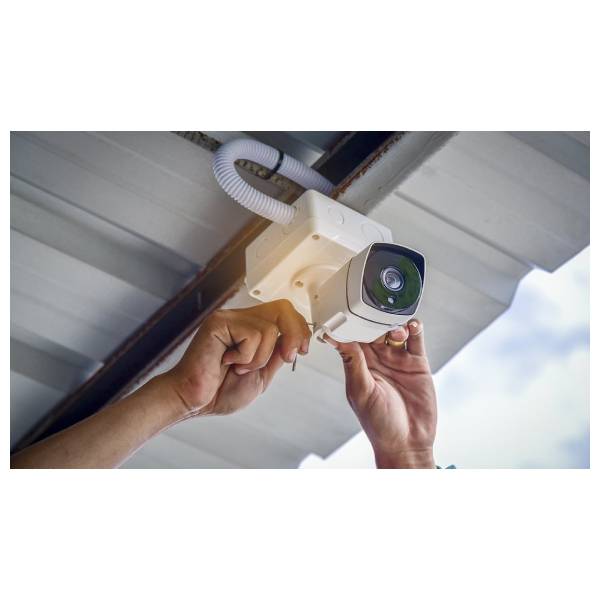


CCTV SYSTEM
A Closed-Circuit Television (CCTV) System is an electronic surveillance solution designed to monitor, record, and protect people, property, and assets. Unlike broadcast television, CCTV transmits video signals through a closed network, allowing authorized users to view live footage and recorded events in real time. Modern CCTV systems integrate advanced technologies such as high-definition imaging, artificial intelligence (AI), remote monitoring, and video analytics to enhance security and operational efficiency.
Key Components
A standard CCTV System consists of four main parts:
Cameras: Capture video footage of monitored areas. Cameras are available in various types, including dome, bullet, PTZ (Pan-Tilt-Zoom), fisheye, and thermal cameras, depending on surveillance requirements.
Recorder: The device that stores video recordings from the cameras. This can be a Digital Video Recorder (DVR) for analog systems or a Network Video Recorder (NVR) for IP-based systems.
Network & Transmission: The communication infrastructure that connects cameras to the recorder and monitoring devices. This may include Ethernet cables, fiber optics, wireless networks, or Power over Ethernet (PoE).
Monitoring & Management Software: The platform that enables users to view live video, playback recordings, configure cameras, receive alerts, and manage the entire surveillance system from local or remote locations.
Primary Functions
Real-Time Surveillance: Continuously monitors facilities to detect suspicious activities, security threats, or operational issues as they occur.
Video Recording & Evidence: Records and stores video footage that can be reviewed for incident investigation, compliance, and legal evidence.
Remote Monitoring: Enables authorized users to access live and recorded video securely from computers, smartphones, or tablets over a local network or the Internet.
Intelligent Video Analytics: Utilizes AI-powered features such as motion detection, facial recognition, people counting, intrusion detection, license plate recognition (LPR), and object tracking to improve situational awareness and reduce false alarms.
Types of Systems
Analog CCTV: Uses coaxial cables to transmit video signals to a DVR. It is a cost-effective solution suitable for basic surveillance applications.
IP CCTV: Employs network cameras that transmit high-resolution digital video over Ethernet networks to an NVR, offering superior image quality, scalability, and advanced intelligent features.
Cloud-Based CCTV: Stores video recordings securely in cloud servers, enabling remote access, centralized management, automatic backups, and scalable storage without relying solely on on-site recording devices.