


PUBLIC ADDRESS SYSTEM
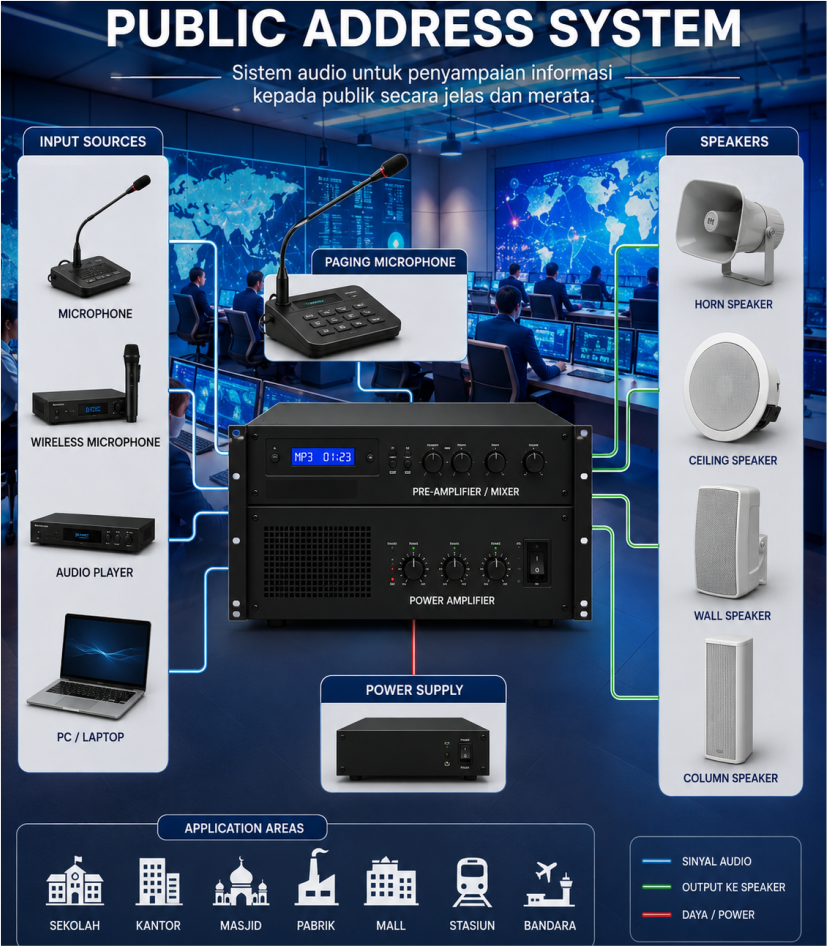
A Public Address System is an audio communication solution designed to distribute clear and intelligible voice announcements, emergency notifications, and background music across buildings or large public areas. It consists of microphones, amplifiers, loudspeakers, and control equipment working together to ensure effective communication for daily operations, public information, and emergency situations. Modern Public Address Systems can be integrated with fire alarm, Building Management Systems (BMS), and Voice Alarm (VA) systems to provide automated emergency broadcasting and centralized audio management.
Key Components
A standard Public Address System consists of four main parts:
Audio Input Devices: The sources of audio signals, including microphones, paging consoles, media players, and emergency message generators that initiate announcements or background music.
Controller & Audio Processor: The central unit that manages audio routing, prioritizes announcements, controls paging zones, and processes audio signals for optimal clarity and system performance.
Power Amplifiers: Devices that amplify low-level audio signals into high-power outputs capable of driving multiple loudspeakers across various zones.
Loudspeakers: The output devices that broadcast announcements and audio throughout the facility. Common types include ceiling speakers, wall-mounted speakers, horn speakers, and column speakers, selected according to the application and environment.
Primary Functions
Voice Announcements: Delivers live or pre-recorded messages for operational communication, visitor information, and staff coordination throughout the facility.
Emergency Broadcasting: Provides priority emergency announcements, evacuation instructions, and warning messages by integrating with fire alarm and life safety systems to support occupant safety.
Background Music Distribution: Broadcasts background music across designated zones to enhance the environment in offices, shopping centers, hotels, airports, and other public facilities.
Centralized Audio Management: Enables operators to control multiple paging zones, adjust audio levels, schedule announcements, and monitor system status from a single management platform.
Types of Systems
Standalone Public Address System: Operates independently within a single building or small facility using local amplifiers and paging equipment, making it suitable for schools, offices, retail stores, and places of worship.
Networked Public Address System: Connects multiple controllers and audio devices over an IP network, allowing centralized paging, multi-zone audio distribution, and system monitoring across large buildings or campuses.
IP-Based Public Address System: Utilizes Ethernet networks and IP-enabled audio devices to deliver scalable, high-quality audio communication, remote management, and seamless integration with Voice Alarm (VA), Building Management Systems (BMS), and other intelligent building systems.